Verification
Manufacturer-specific selectivity
Selectivity tables are manufacturer-specific — mixing vendors creates verification gaps.
Semiconductor technology switches in under 50 microseconds — faster than any main fuse.

Selectivity tables are manufacturer-specific — mixing vendors creates verification gaps.
Up to ten protection and measurement functions per final circuit — each with its own selection and coordination.
Existing distribution boards dictate layout and conductor cross-sections — selectivity must be integrated, not engineered from scratch.
The Siemens SENTRON ECPD switches in under 50 microseconds. Faster than any upstream fuse can react — and therefore selective without calculation.
For ECPD-protected final circuits, selectivity planning is eliminated. Semiconductor-based switching in ~50 µs stays below the response threshold of any electromechanical protective device — the upstream level never trips. Oversizing upstream protective devices and cables, otherwise required to achieve selectivity, also becomes unnecessary.
Icu = 75 kA · I²t < 30 A²s · 2,400× lower than MCB
Circuit protection (MCB), residual current protection (RCD), SPD tripping, current, voltage and power measurement, remote switching, residual current monitoring (RCM). One device on 2 MW instead of eight devices on 16 MW. That reduces component selection, wiring effort and control cabinet width — at 60% lower power loss.
10 products → 1 product · 16 MW → 2 MW · 18 W → 7 W
Rated current (2–16 A), trip sensitivity (18 / 22 / 27 mA), tripping behavior and undervoltage release are set via the SENTRON Powerconfig app. One device variant covers what would otherwise require multiple order numbers — simplifying stocking and late changes during planning.
In: 2–6 / 6–10 / 10–16 A · IΔn: 30 mA Type F · IEC/EN 61009-1
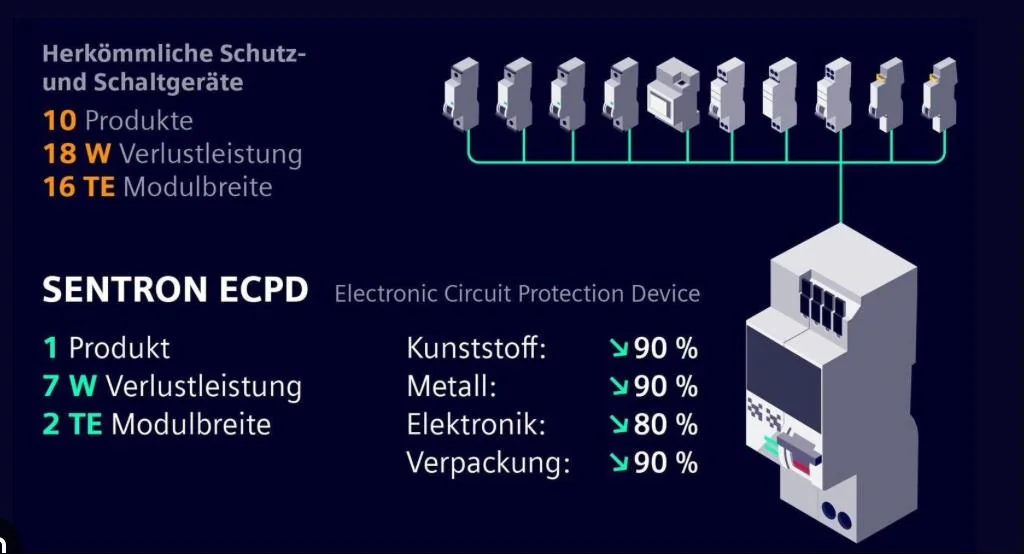
What happens when a short circuit occurs in a final circuit.
Unused loads are switched off selectively via remote switching — instead of running around the clock because re-energizing would cause inrush problems. At the Siemens electronics plant in Amberg, this saves up to 9,000 kWh per year on a 12 m² LED wall.
~9,000 kWh/year · ~€1,800/year · EWA reference
In day-to-day operation, guaranteed selectivity means: a short circuit in one final circuit takes down only the affected circuit, not the entire area. At an international financial group, more than 600 ECPDs protect individual trading desks without shutting down the whole floor.
> 600 ECPDs deployed · financial sector
The cyclical self-test replaces manually pressing the RCD test button, and remote access enables diagnostics and reclosing without an on-site visit. ROI versus conventional RCD/MCB solutions in under 3.4 years.
cyclical self-test with logging · ROI < 3.4 years
The ECPD is part of the SENTRON range — the same family you know from conventional protective switching devices.
CE declaration of conformity. Compliance with the key protection objectives of DIN VDE 0100-4xx. The product standard IEC 63464-1 (SC-RCBOs) is in preparation — publication planned for 2028.
SENTRON is the Siemens low-voltage product range with decades of market presence. The ECPD extends this range with semiconductor-based functions.
Encrypted wireless communication (ZigBee, BLE). Configuration protection with local device authentication. Signed firmware only. Shipped secure by default.
Metered, switchable circuits integrated into the higher-level control system. Remote shutdown outside office hours.
Bremen · 26 outgoing circuits
Selectivity at workstation level. A short circuit at one station does not affect the neighboring circuit.
Measurement and control technology
Desk-level selectivity at an international financial group. A failure at one trading desk does not take down the entire floor.
> 600 ECPDs installed
Data sheet, integration, white paper — exactly what you need.
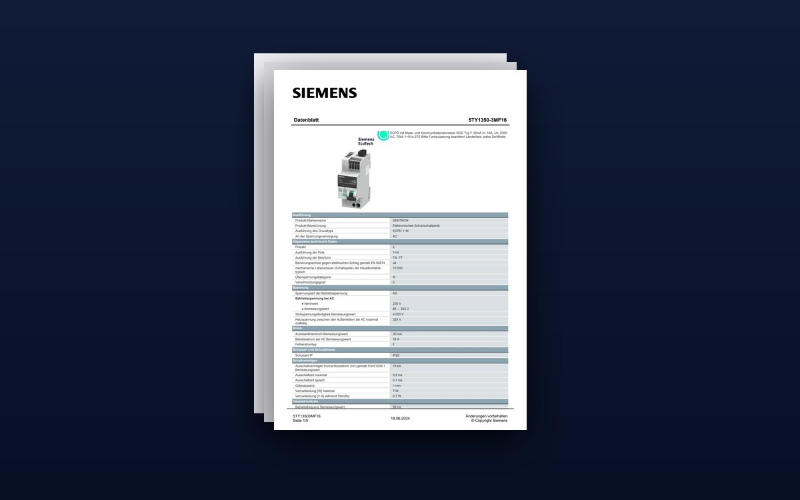
Technical specifications, dimensions, certifications.
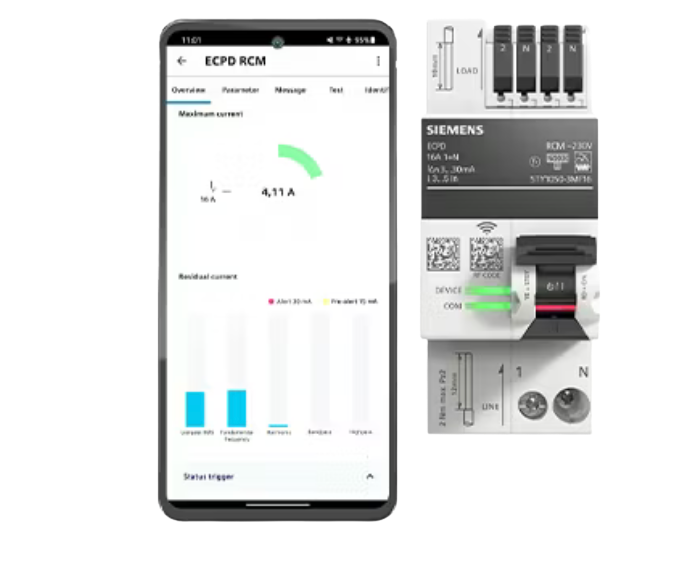
Connection to Powerconfig, Modbus, control systems.
Fundamentals of modern protective switching technology. PDF · German.
Selectivity check, DIN rail layout, metering and switching concept — whatever your current planning phase calls for.